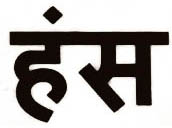
The Hong Sau Kriya Meditation Technique
Transcribed recording of a personal conversation with Ray Grasse
You have to use the Hong Sau technique because you just want to enjoy it.
When you're doing Hong Sau, you keep only one thing in mind: you are sitting here as an observer. This is where you are. And you're watching the air flow up and down your nostrils. So when it flows up your nostrils, of and by itself, without any effort on your part, you mentally chant "Hong." When you feel the air flow out of your nostrils, of and by itself, you mentally chant "Sau."
And that's all there is to Hong Sau. That's how simple it is.
If you're trying to make it do something, you're doing something wrong. All you're doing is: you are an observer. You are observing what happens and you are not trying to do anything else. If some other thought comes in, that's an extraneous thought. You say, "Yes, I'll think about you later. This is the time for meditation."
If you do anything else but observe, you're doing something wrong. If you're uncomfortable, you're doing something wrong. In Hong Sau, you must be comfortable, and you are just observing. And remember, you don't do it too soon after you've eaten: that's disturbing. Nor do you wait until you're too hungry: that's disturbing. It shouldn't be too humid, it shouldn't be too cold, and it shouldn't be too hot. And not too light or too dark.
In other words, everything is geared towards the idea of sameness. The posture must be in balance as much as possible. So sit as close to the lotus pose as you possibly can, but sitting on a chair is OK. You sit there and you watch the air as it goes up your nasal passage where you mentally chant "Hong" and it goes down your nasal passage where you mentally chant "Sau."
Hong Sau is Sanskrit for one thing: it means I am aware that I am. That's all you're saying in Sanskrit with Hong Sau. That's what it means. So it's like you're mentioning the name of God in Sanskrit: Hamsa is what it comes out to be. And I am aware that I am indicates that you're striving towards balance.
One Hong Sau, done with enjoyment, will produce greater results than a hundred thousand Hong Saus done with drudgery. If it's a task, you'll find a reason to stop the task. If it's done with enjoyment and pleasure, you'll find a reason to meditate.
Before you do your meditation, associate and remember how this might be like the night before Christmas. Don't you like to get associated with those things that you enjoy? Don't you know what you enjoy and what you do to get that feeling of enjoyment? Isn't sex an enjoyable pleasure? Think about sex and feel enjoyment. Now try and feel that enjoyment, the climactic condition of sex, in Hong Sau. You're substituting there. You're sitting there, and you're trying to feel the sex pleasure within your being when you're breathing Hong Sau, as though the breath is a sex act. In fact, it is a sex act.
And so when you sit, you do Hong Sau with pleasure. You do it with pleasure. Now you're associating meditation with the concept of pleasure. How can you get the Samadhi state of awareness by any form or means which involves effort? It's a state of imbalance. You're not going to get that bliss by doing something which is uncomfortable. This should be comfortable. You must associate the technique with it.
After a couple of months when you're doing one Hong Sau and you've got an associated pleasure, then you can start doing two Hong Saus. If an extraneous thought comes in, you think "Yes, I know you're important, but it is more important to meditate at this moment than to think." And by the time three extraneous thoughts are coming, you stop and say, "Now I will think about you." and you think about them.
See, you tell those thoughts that they are very important and you will think about them later - but meditation is important now. Then you stop thinking and you go back to your meditation. But don't forget about them. You must be true unto yourself, so that the whole thing you are beginning to develop, in other words, what you're learning, is controlled awareness. Self-discipline is taking place, that's what it's all about.
Spiritual unfoldment is self-discipline. For that reason, they say many things are sin. Sex is one of the main ones. Is sex controlled? Self-disciplined? Think of how much self-control this produces if you control it. Or do you let it control you? If you let it control you, who is under what influence? This is the whole problem of drinking alcohol: it controls you in the opposite direction to which God wants you to go.
Can these influences be used as tools ? Yes, they can all be used as tools, provided you are in control. As long as you are controlling them, instead of them controlling you. There's nothing wrong with alcohol, providing it's done in moderation. Anyone that lets alcohol control him...
A lot of people view meditation as a task and they never get to the point where the Kriya is automatic. What do I mean by automatic? I mean that when you sit down to breathe Kriya, you don't have to think about it. It's the same when you sit down to play your piano. You see your notes and you don't have to think about where your fingers are going to go - they go there automatically. As soon as your eyes see the notes, your fingers are there, are they not, without thought? Right. You feel the music. You're not thinking "This is the key of G, this note is A, this note is B." You see this group of notes and your hand automatically plays that chord, right?
When your Kriya is as automatic and as effortless as that, then you're breathing Kriya properly and it begins to produce effects. But if you have to think about it, so that your Kriya is not automatic, not effortless, you're still learning the technique of it and getting it as a source of habit. You have to practice more. It must be an effortless habit. That's what it must be.
Meditation leads to controlled awareness. Controlled awareness is self-discipline. Self-discipline leads to God Consciousness. There is no other way.
Editor's Note: There are regional differences in India with respect to Sanskrit pronunciation. Shelly's teacher Yogananda, of Bengali origin, pronounced Ham as "Hong", and Sa as "Sau". Hamsa means swan, a bird revered by Hindus as a symbol of spiritual unfoldment. Hamsa is the inverted form of Soham, which means "I am That".